

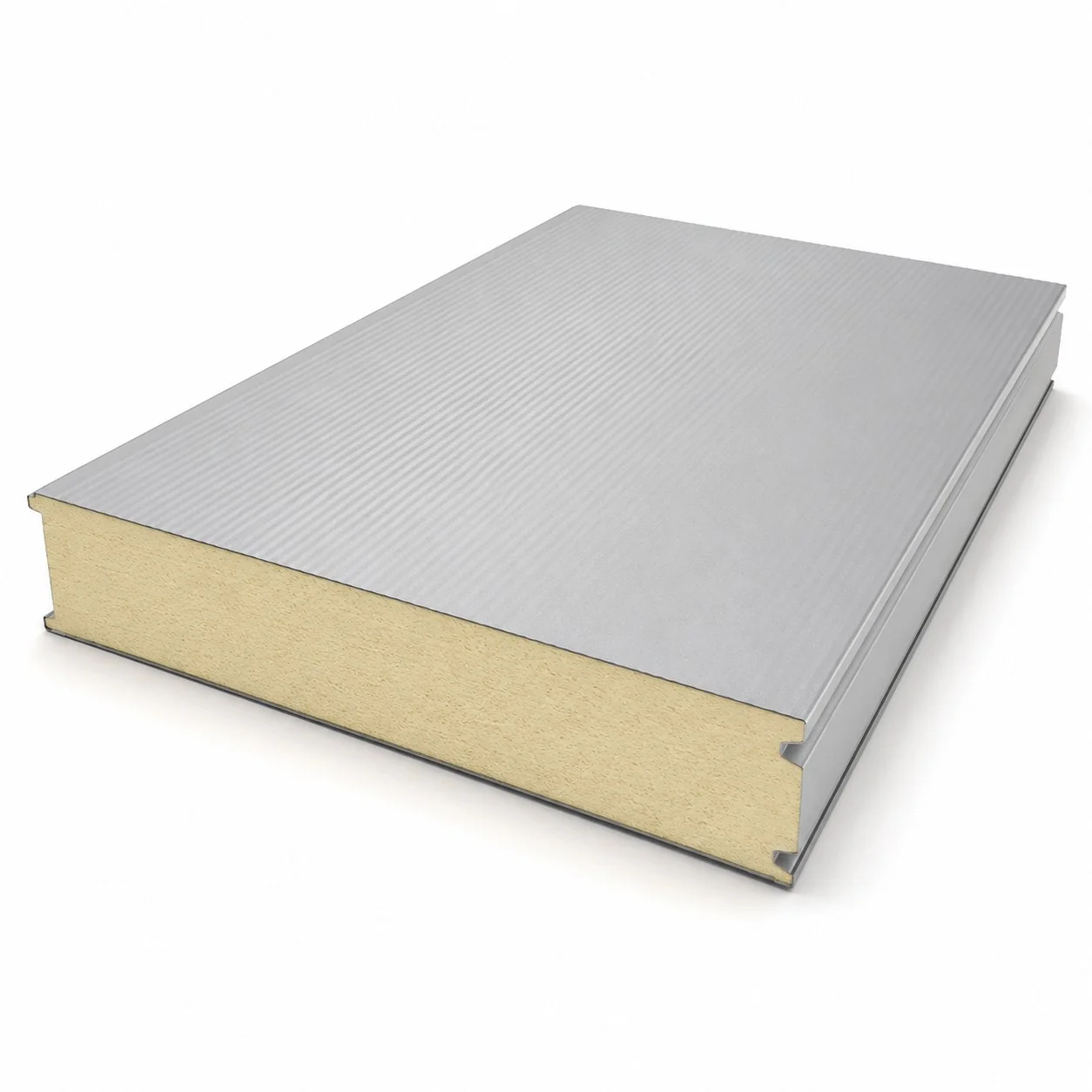
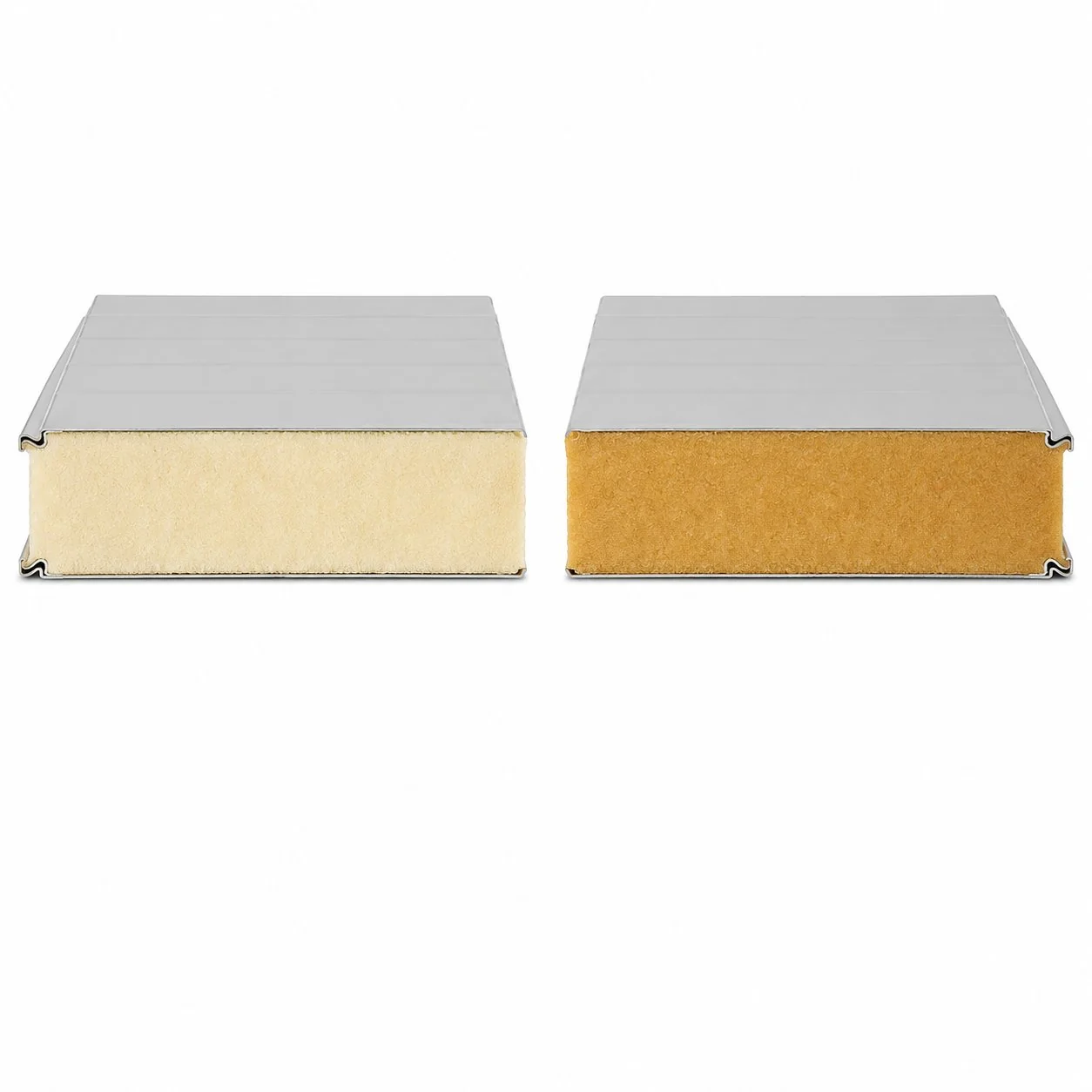
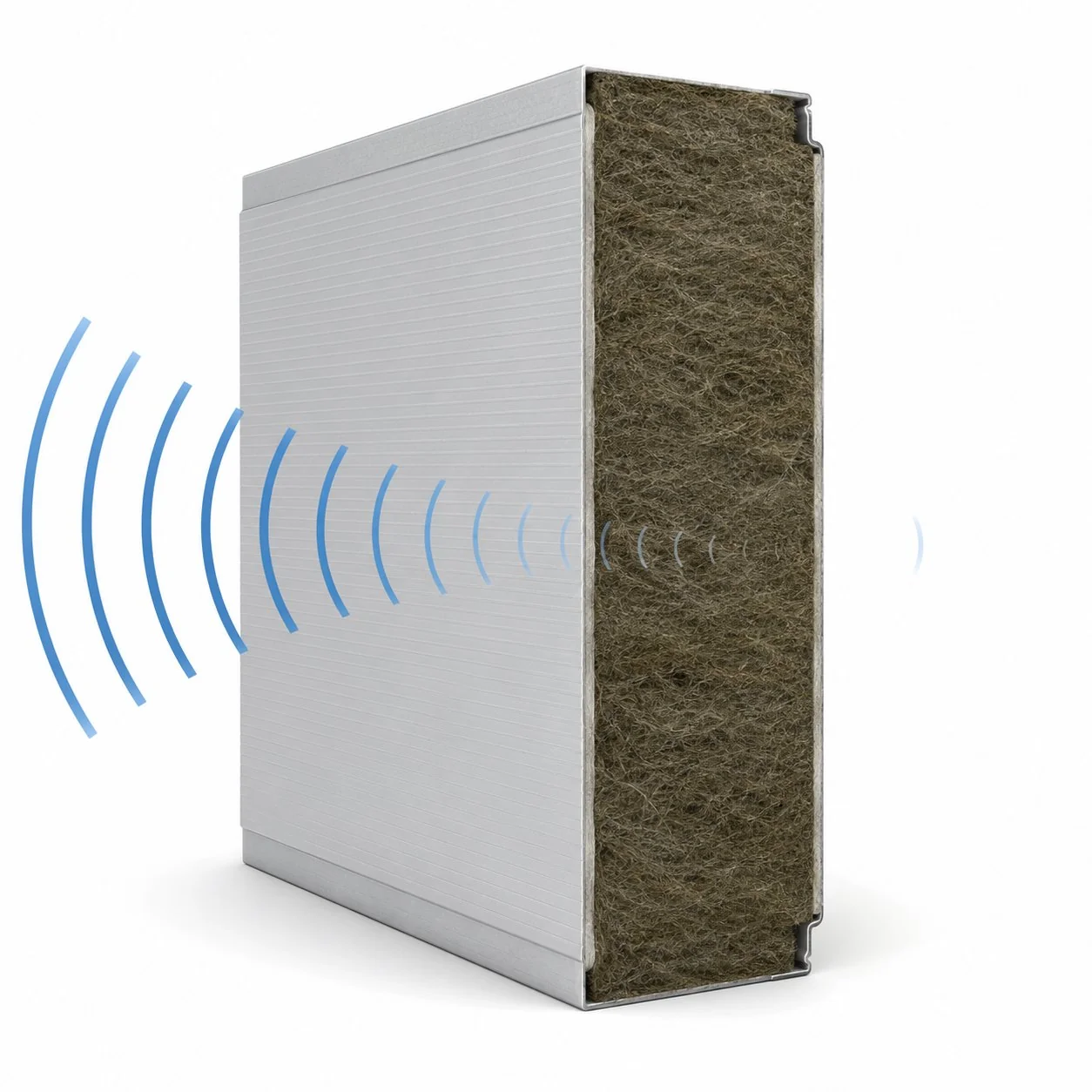
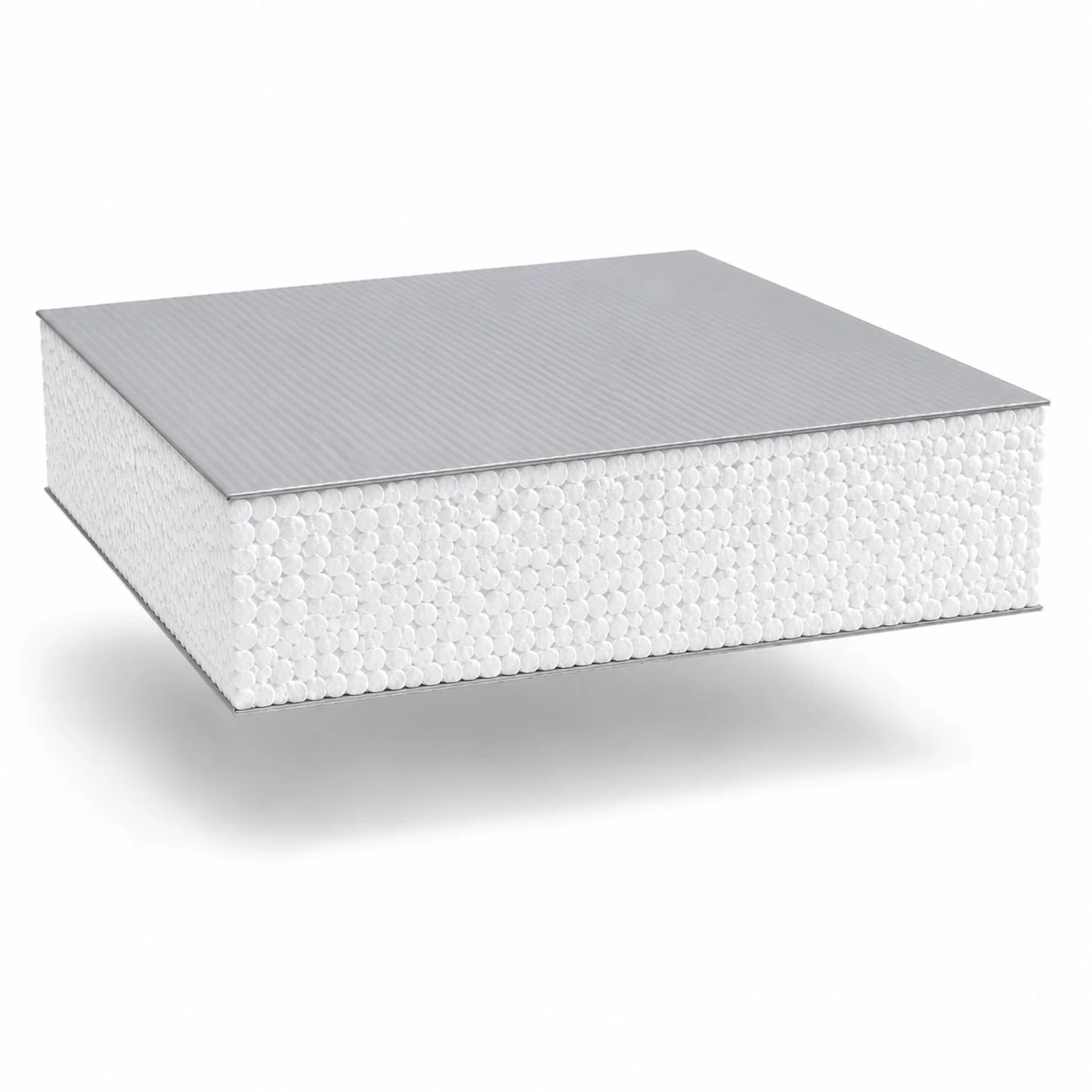
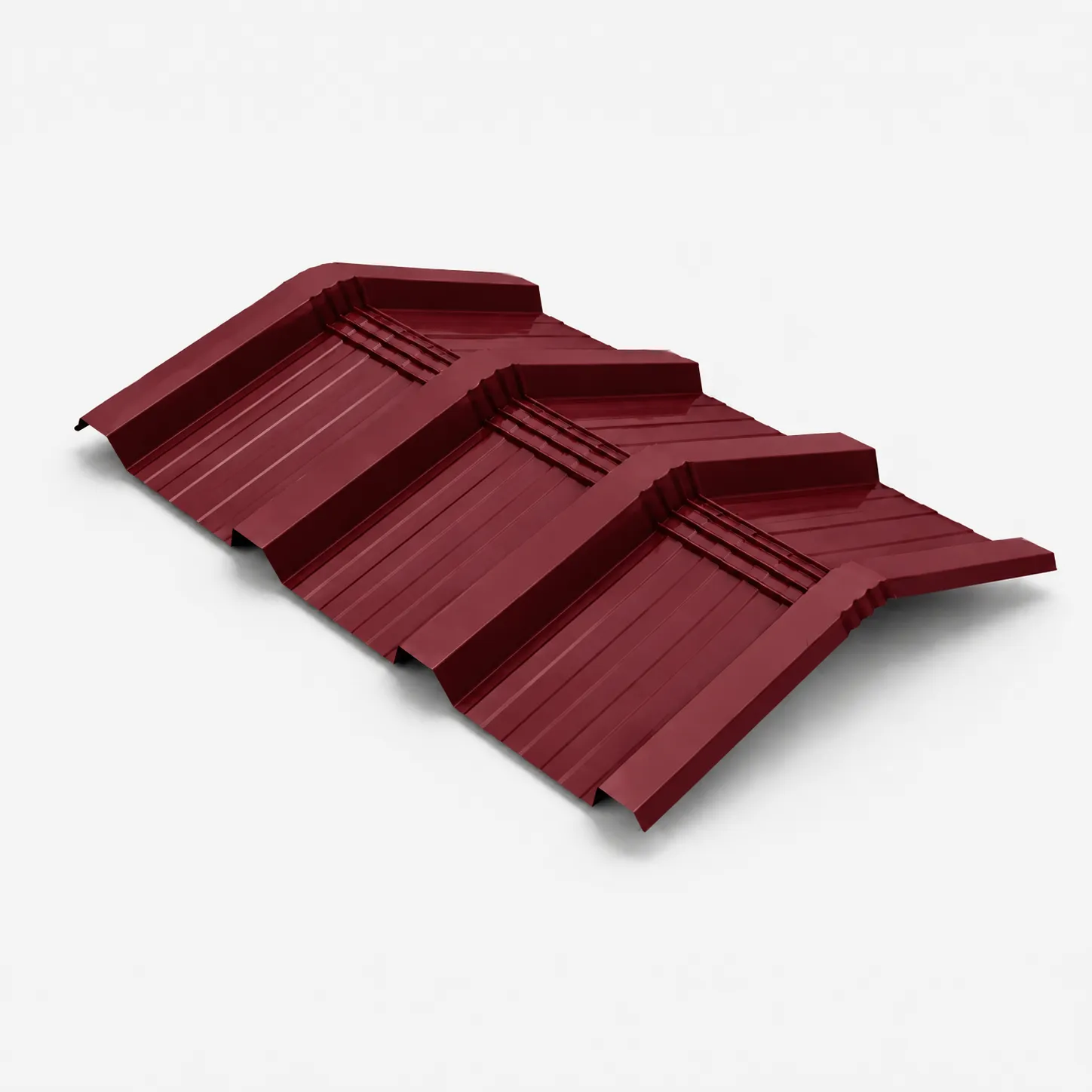
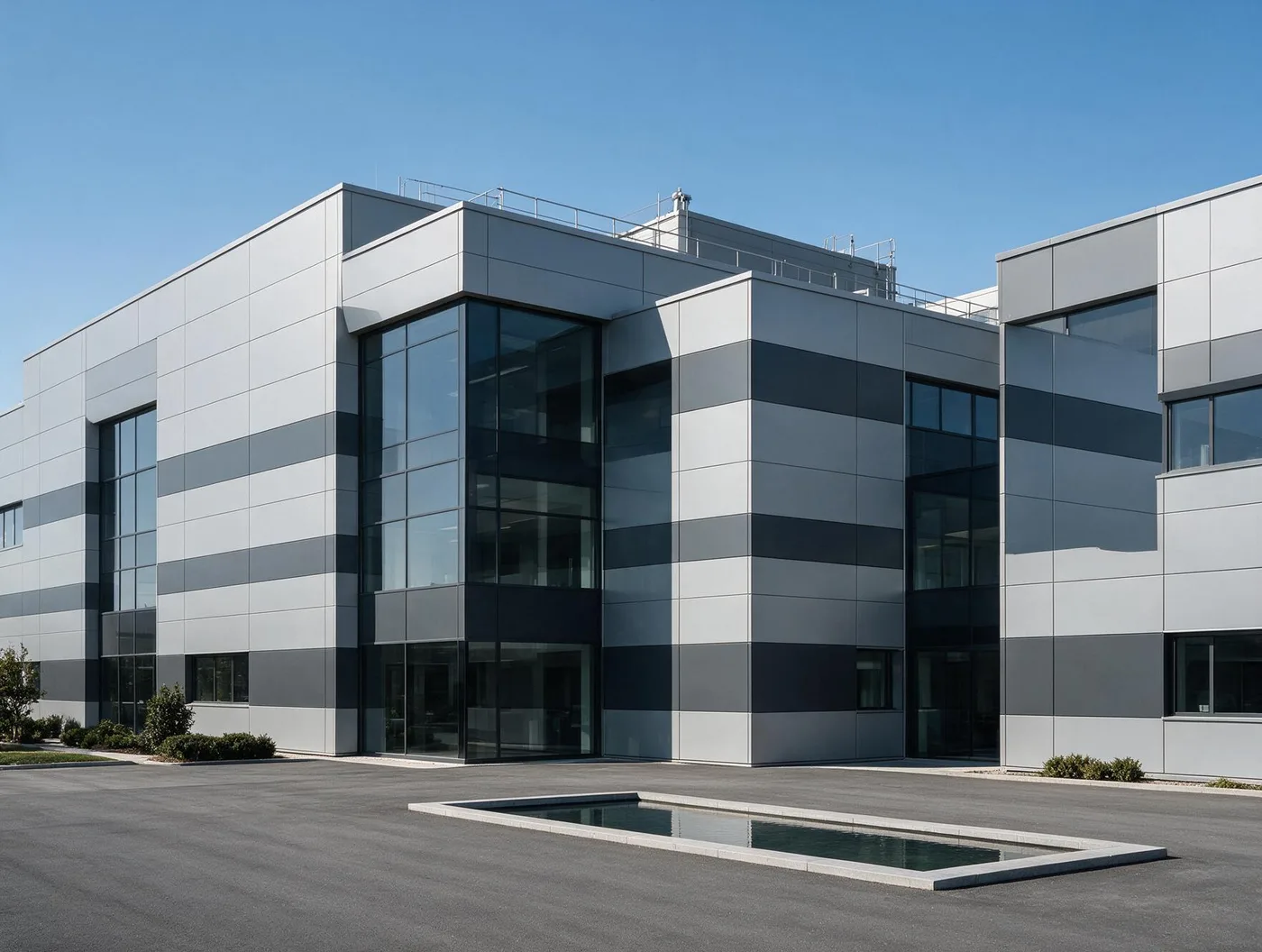
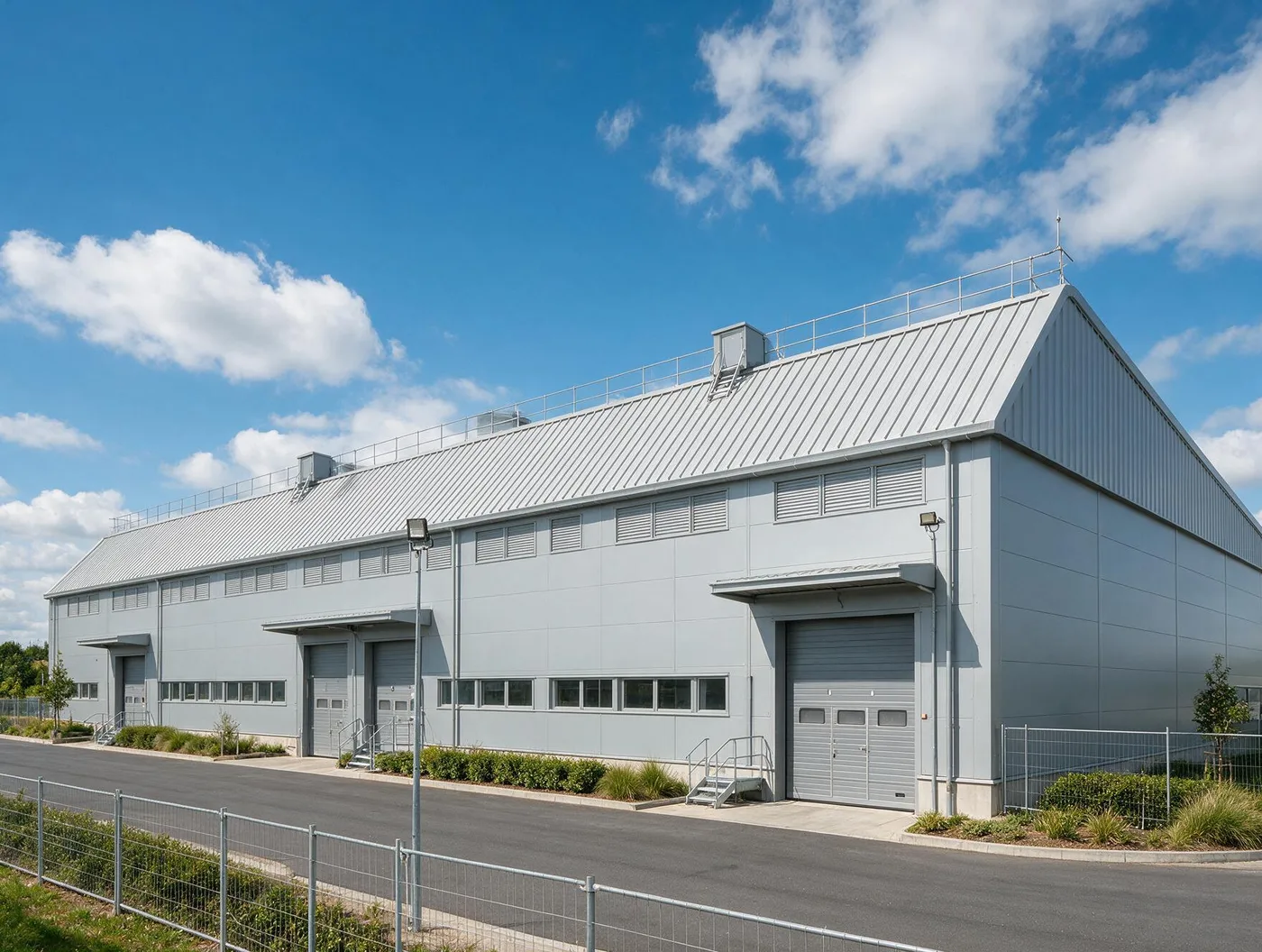
Sandwich panel core comparison is the most important decision in specifying insulated building cladding. The core material — polyurethane (PUR), polyisocyanurate (PIR), expanded polystyrene (EPS), or stone wool (rockwool) — determines every performance characteristic of the panel: thermal insulation, fire reaction, acoustic behavior, weight, and cost. Choosing the wrong core wastes money; choosing the right one optimizes building performance for decades.
This comprehensive sandwich panel core comparison guide examines all four materials across seven performance criteria, with clear recommendations by building type. Whether you are specifying panels for an industrial factory, commercial office, cold storage facility, or agricultural building, this guide gives you the data to make the right choice. For manufacturer-specific specifications, explore our complete product range.
On this page:
- The 4 core materials at a glance
- Sandwich panel core comparison: 7-criteria table
- Thermal performance (lambda)
- Fire reaction (Euroclass)
- Acoustic performance (Rw)
- Weight & structural impact
- Moisture resistance
- Cost analysis
- Environmental profile
- Best core material by building type
- Hybrid strategies — combining core materials
- How to specify the right core — decision framework
- Frequently asked questions
The 4 core materials at a glance
Before diving into the detailed sandwich panel core comparison, here is a quick summary of each material:
PUR (polyurethane)
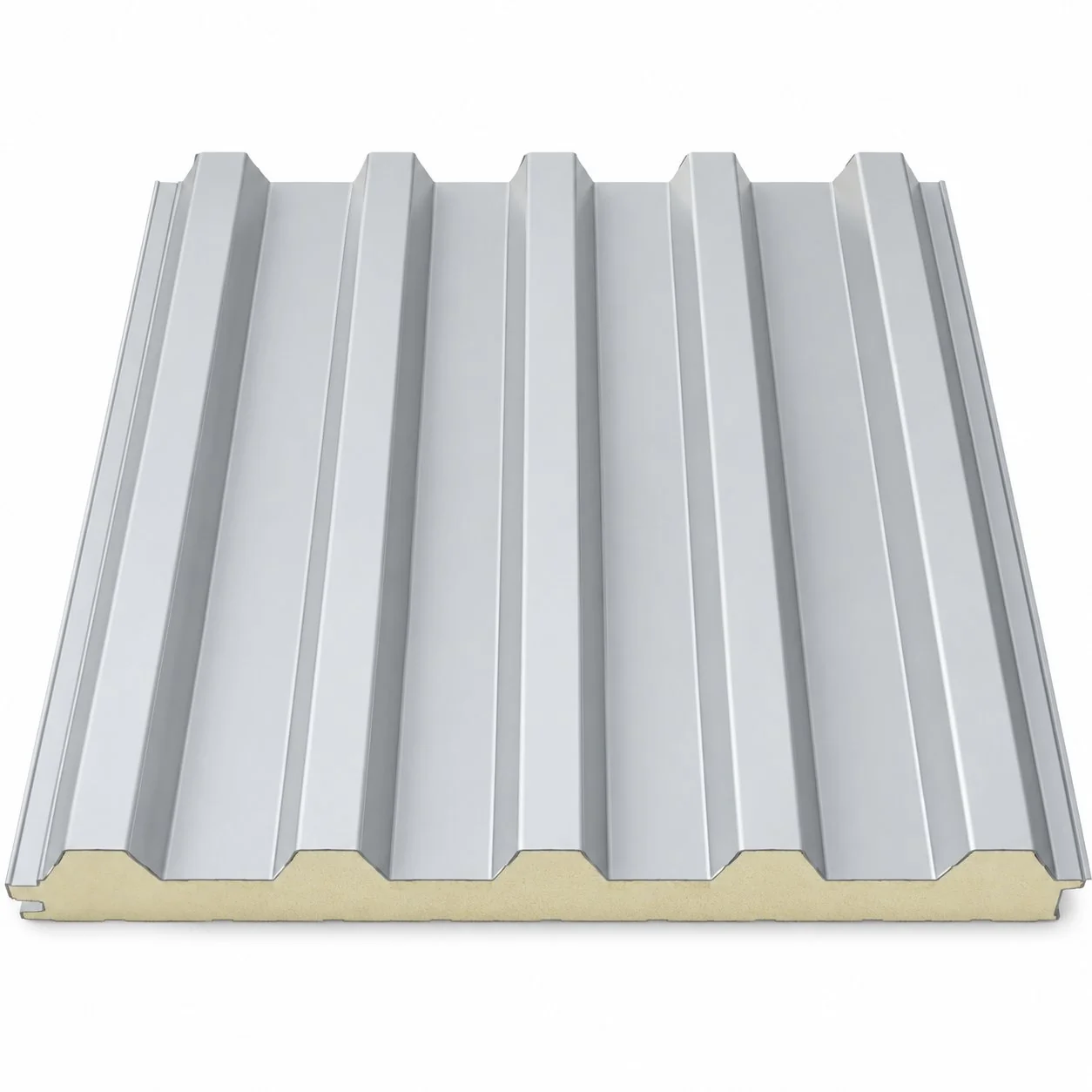
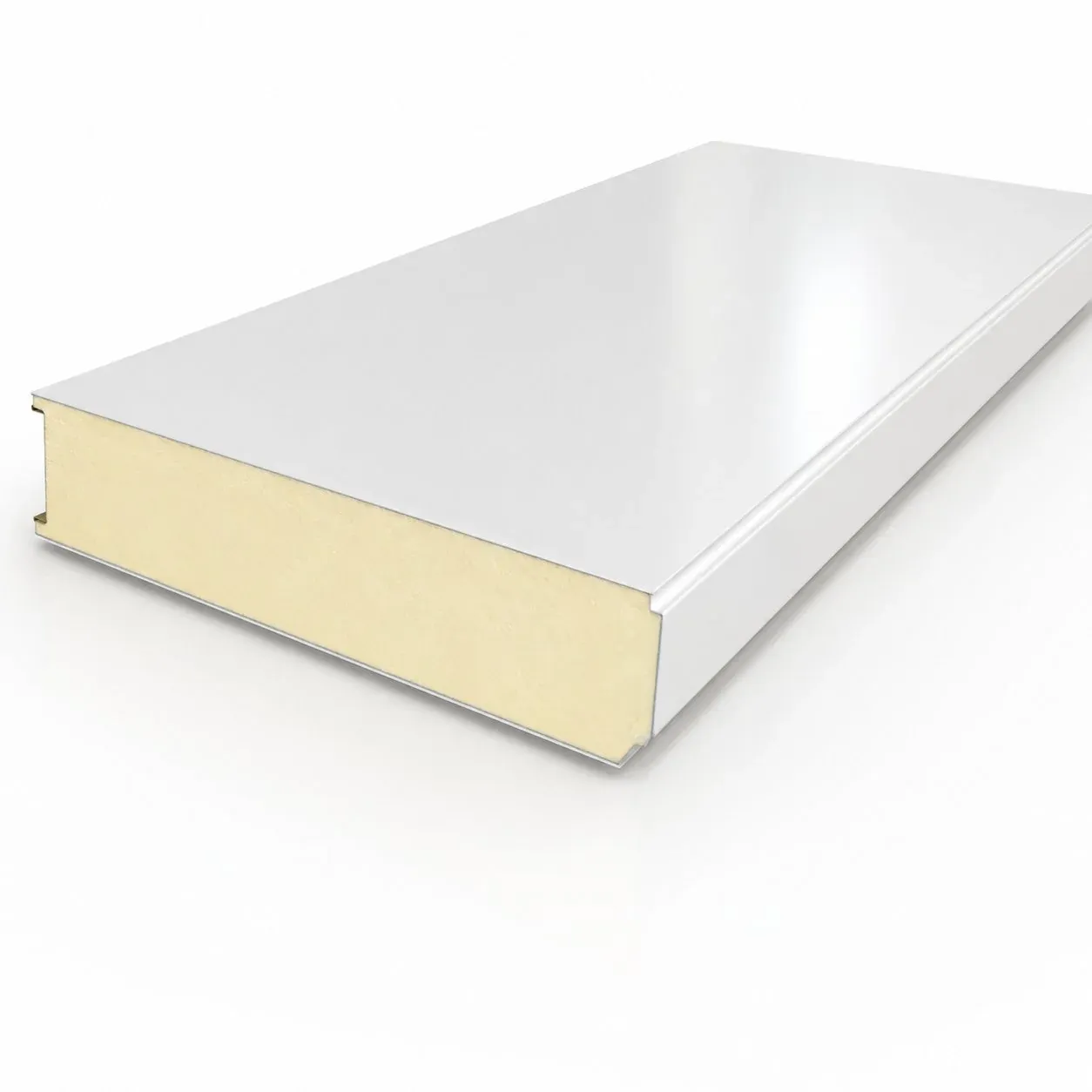
The all-round champion. PUR delivers the best thermal insulation per millimeter (lambda 0.022 W/mK) at a competitive price. It is the default core for most industrial, commercial, and agricultural sandwich panels worldwide. Fire class B-s2, d0. Our PUR facade panels, PUR roof panels, and PUR cold room panels use this core.
PIR (polyisocyanurate)
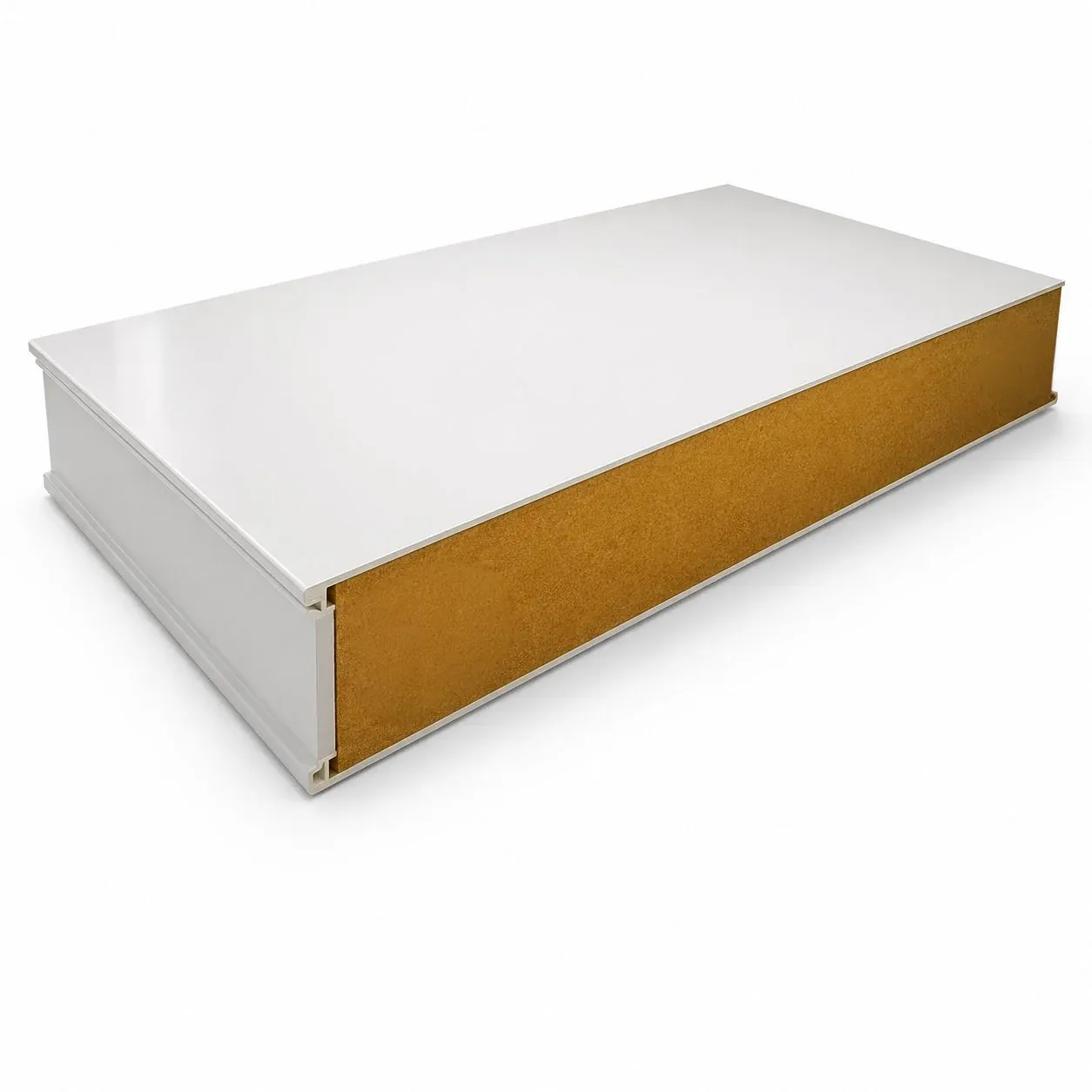
The fire-enhanced upgrade. PIR is chemically similar to PUR but modified for better fire performance — achieving B-s1, d0 (very low smoke). Thermal performance is nearly identical (lambda 0.023). PIR costs approximately 10-15% more than PUR. Our PIR facade panels, PIR roof panels, and PIR cold room panels.
EPS (expanded polystyrene)
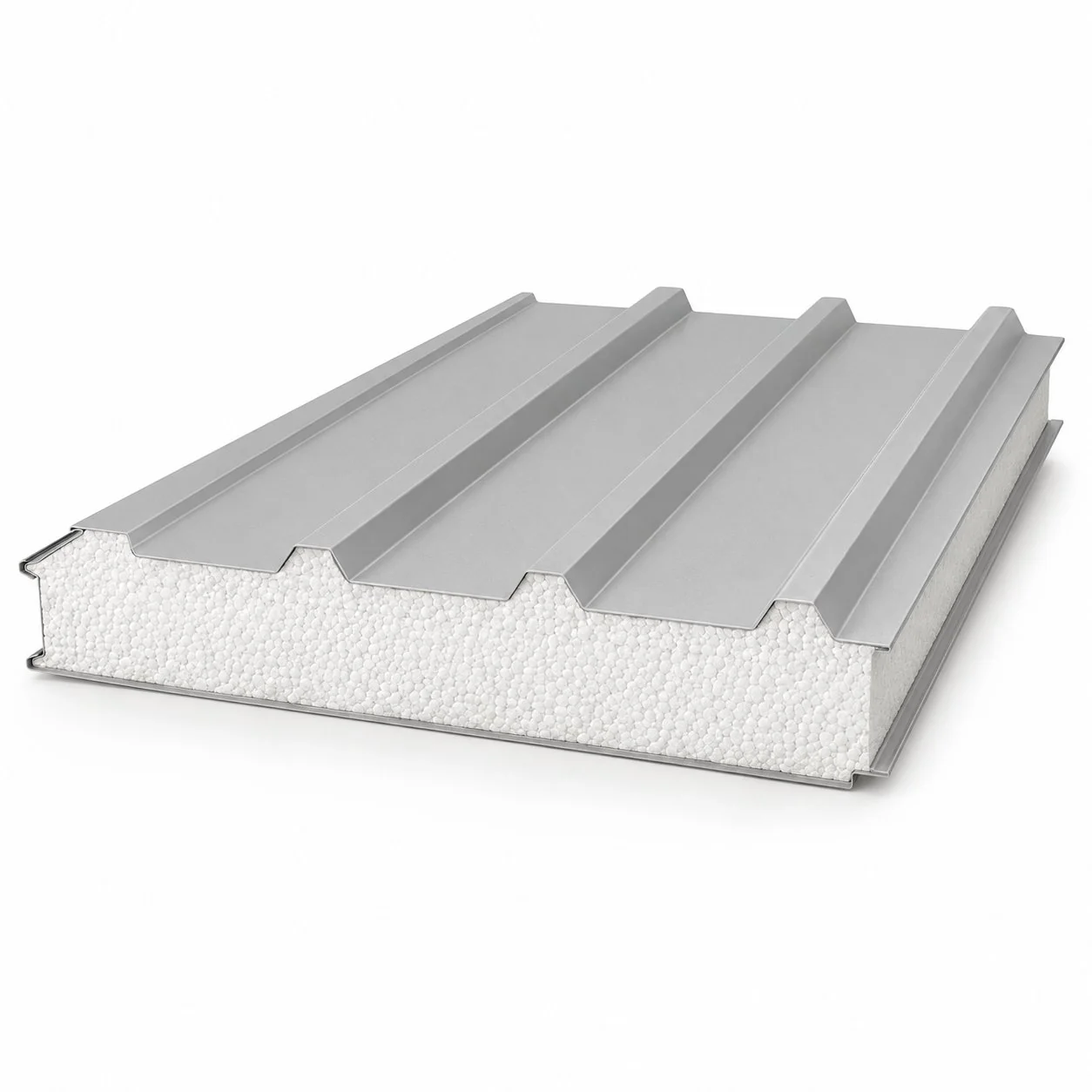
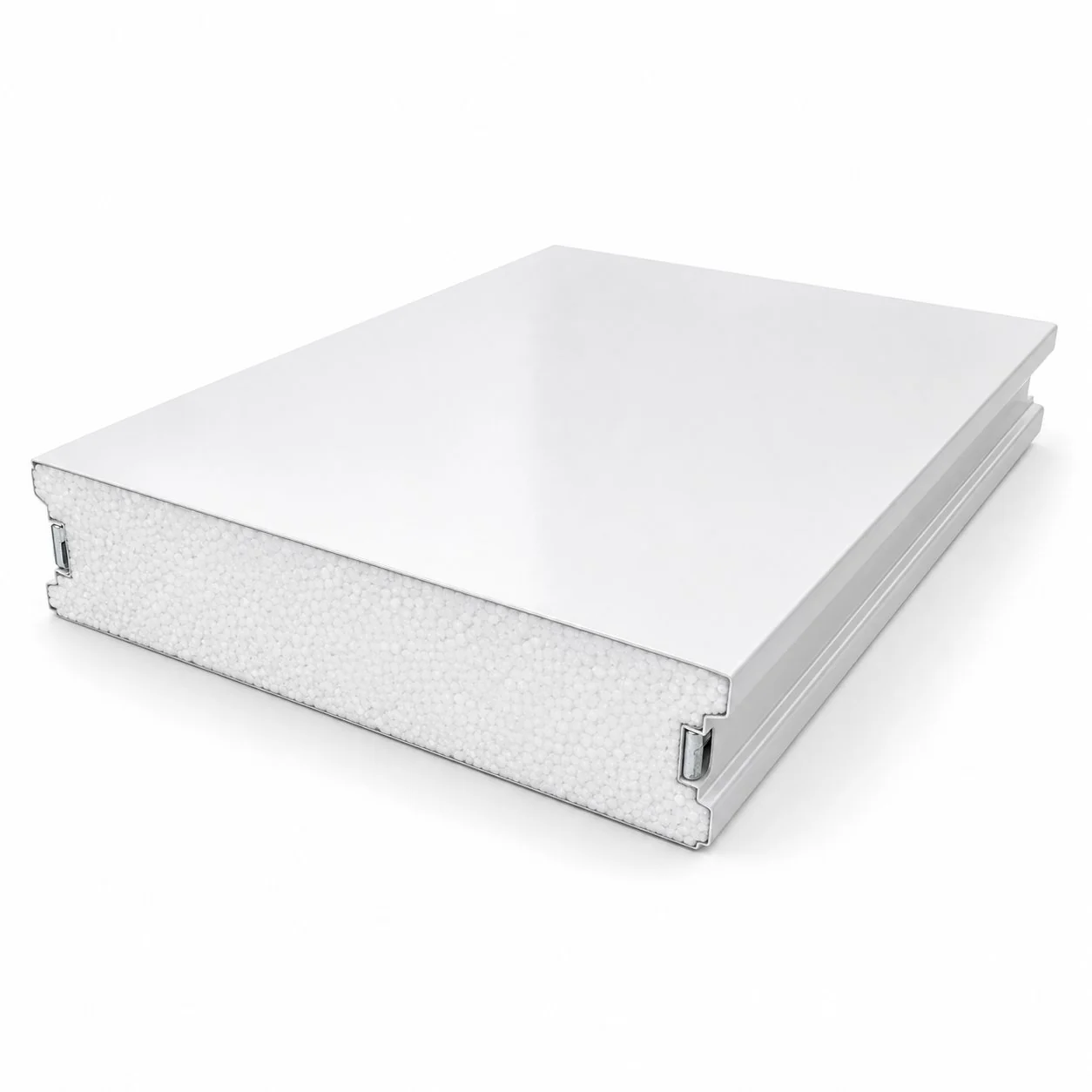
The budget option. EPS offers the lowest material cost but requires 50-70% more thickness to match PUR’s thermal performance (lambda 0.035). Fire class E. Best for budget-driven projects where thickness and fire rating are not critical. Our EPS facade panels, EPS roof panels, and EPS cold room panels.
Rockwool (stone wool)
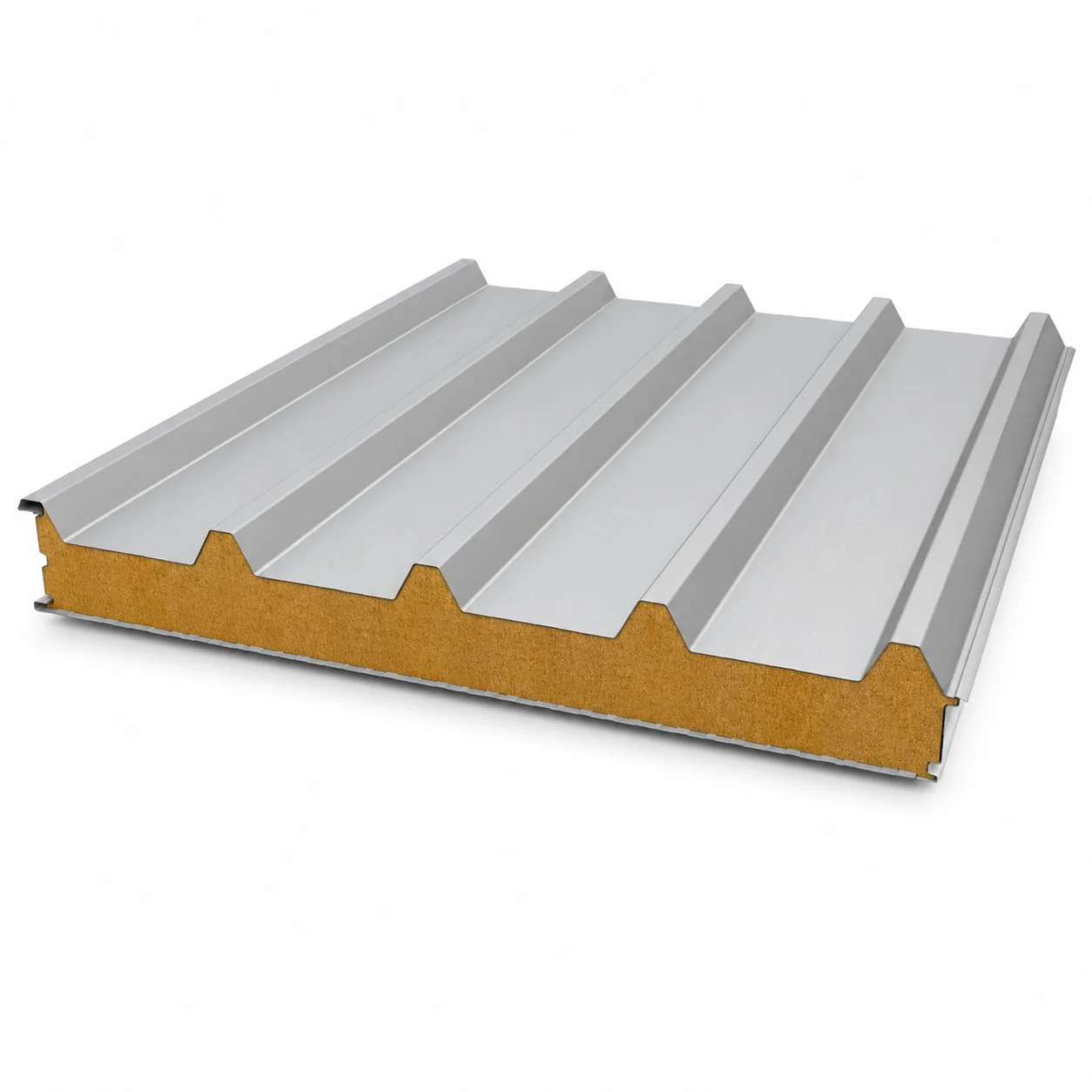
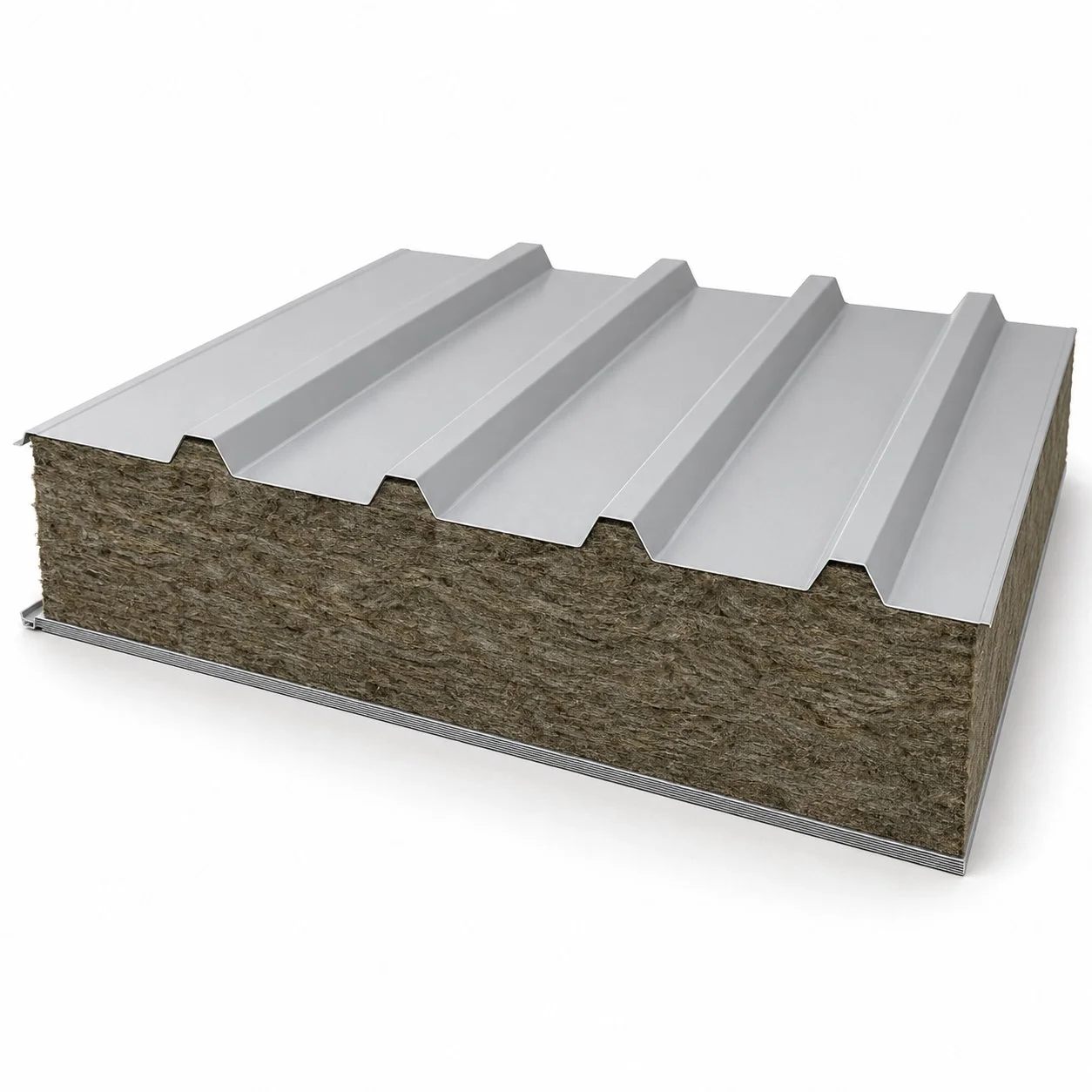
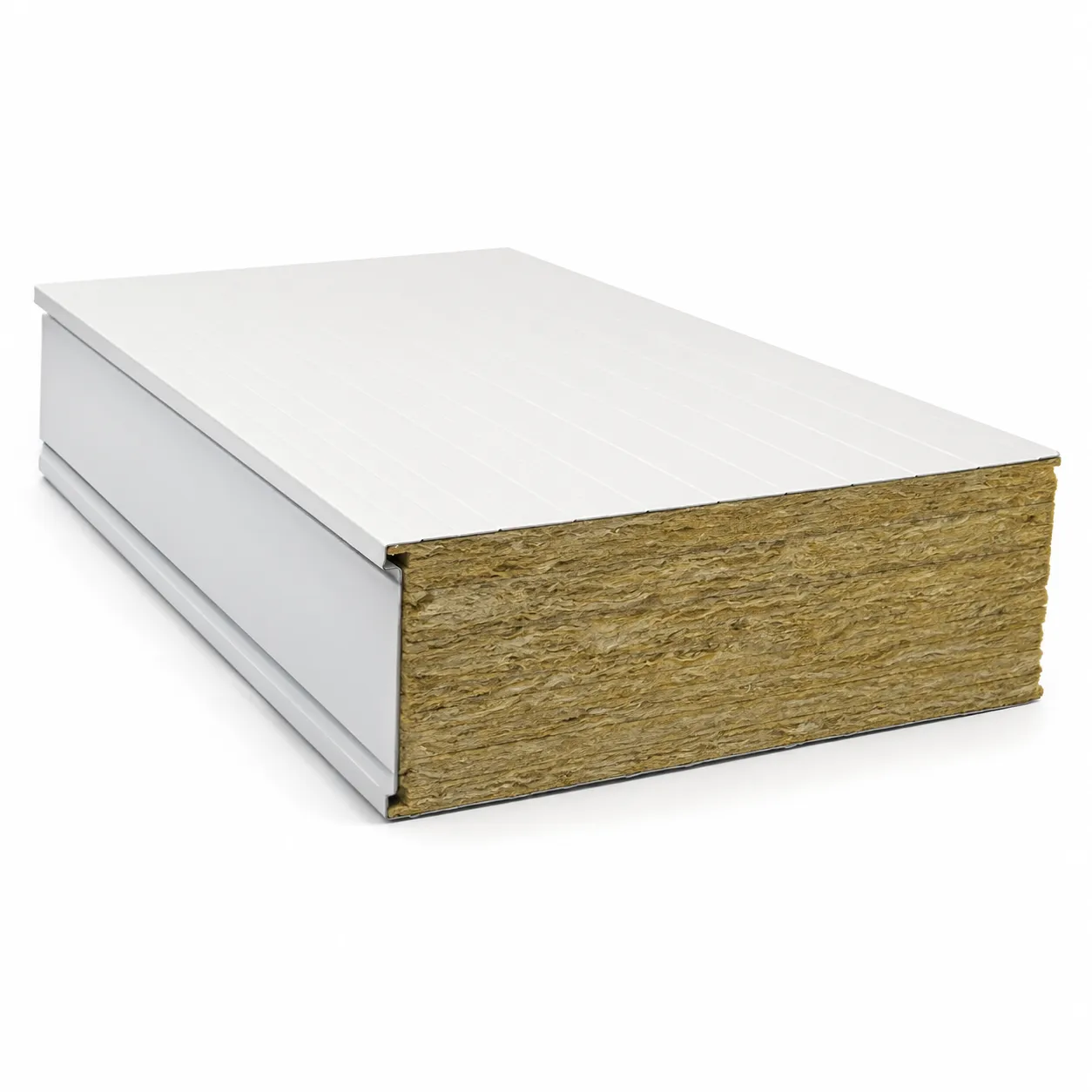
The specialist. Rockwool is the only non-combustible core (A1/A2) and the only core with meaningful acoustic performance (Rw up to 33 dB). It is the heaviest and requires the greatest thickness for equivalent thermal performance (lambda 0.040). Our rockwool facade panels and rockwool roof panels.
Sandwich panel core comparison: 7-criteria master table
This is the definitive sandwich panel core comparison table. Bookmark it — you will refer to it on every project:
| Criteria | PUR | PIR | EPS | Rockwool |
|---|---|---|---|---|
| Lambda (W/mK) | 0.022 ★ | 0.023 | 0.035 | 0.040 |
| Fire class | B-s2, d0 | B-s1, d0 ★ | E | A1/A2 ★ |
| Smoke class | s2 (low) | s1 (very low) ★ | s3 (high) | s1 (very low) ★ |
| Rw (100mm) | 23 dB | 23 dB | 21 dB | 30 dB ★ |
| Weight (100mm) | ~12 kg/m² | ~12 kg/m² | ~10 kg/m² ★ | ~22 kg/m² |
| Moisture resistance | Excellent ★ | Excellent ★ | Good | Moderate |
| Relative cost | Medium | Med-High | Low ★ | High |
| Thickness for U=0.28 | 80 mm ★ | 82 mm | 120 mm | 140 mm |
★ = Best in category. This sandwich panel core comparison shows that no single material wins every category — the right choice depends on your project priorities.
Thermal performance — lambda comparison
Lambda (λ) is the single most important metric in any sandwich panel core comparison for thermal insulation. It measures thermal conductivity in W/mK — lower is better:
- PUR: λ = 0.022 W/mK — best thermal performance per millimeter. 80 mm achieves U = 0.27 W/m²K.
- PIR: λ = 0.023 W/mK — virtually identical to PUR. The fire upgrade costs only 1-2 mm of additional thickness.
- EPS: λ = 0.035 W/mK — requires 50% more thickness than PUR. 120 mm to match PUR’s 80 mm performance.
- Rockwool: λ = 0.040 W/mK — requires 75% more thickness than PUR. 140 mm to match PUR’s 80 mm performance.
For thermal-driven projects, PUR wins this sandwich panel core comparison decisively. Calculate your exact requirement: U-Value Calculator. For full thermal solutions: Thermal Insulation Solutions.
Fire reaction — Euroclass comparison
Fire performance is where this sandwich panel core comparison gets critical. According to the European Euroclass system (EN 13501-1):
- Rockwool: A1 or A2-s1, d0 — non-combustible. Will not burn. Zero smoke. The fire safety champion.
- PIR: B-s1, d0 — limited combustibility with very low smoke. Self-charring mechanism forms protective char layer.
- PUR: B-s2, d0 — limited combustibility with low smoke. Good fire performance for most industrial applications.
- EPS: E — combustible. Self-extinguishes when flame is removed but contributes to fire. Lowest fire rating.
For fire-critical projects (multi-story, public, property boundary): Fire Resistance Solutions.
Acoustic performance — sound insulation
This is the most one-sided result in any sandwich panel core comparison:
- Rockwool: Rw 28-33 dB — genuine sound absorption through mineral fiber friction. The only acoustically effective core.
- PUR/PIR: Rw 22-24 dB — rigid foam reflects sound rather than absorbing it. Minimal acoustic benefit.
- EPS: Rw 20-22 dB — worst acoustic performance. Rigid bead structure provides almost no sound absorption.
If acoustic performance is a project requirement, rockwool is the only answer in this sandwich panel core comparison. Details: Acoustic Insulation Solutions.
Weight & structural impact
Panel weight affects structural steel design, transportation costs, and installation speed:
- EPS: ~10 kg/m² (100mm) — lightest. Minimal structural impact. Easiest to handle.
- PUR/PIR: ~12 kg/m² (100mm) — moderate. Standard structural calculations apply.
- Rockwool: ~22 kg/m² (100mm) — heaviest (nearly 2x PUR). May require heavier purlins and additional structural support. Higher transport costs per m².
Moisture resistance
- PUR/PIR: Excellent — closed-cell foam absorbs virtually zero moisture. Maintains insulation performance in humid environments.
- EPS: Good — closed-cell but can absorb small amounts of moisture at bead boundaries over time.
- Rockwool: Moderate — mineral fibers can absorb moisture if the panel’s steel facing is damaged. Water-repellent treatments help but closed-cell foams are inherently superior for wet environments.
For cold storage and high-humidity applications: Cold Storage Solutions.
Cost analysis
In this sandwich panel core comparison, cost must consider both material price and total lifecycle cost:
- EPS: Lowest panel cost — but requires thicker panels (more steel, more transport volume) and has the poorest fire and acoustic ratings.
- PUR: Best value — moderate panel cost but thinnest panels for any U-value target. Lowest lifecycle cost (panel + energy savings).
- PIR: 10-15% more than PUR — the fire upgrade premium. Often offset by lower insurance premiums and faster building permits.
- Rockwool: Highest panel cost — 30-50% more than PUR at equivalent thermal performance. Justified when fire A-class or acoustic performance is required.
Environmental profile
Sustainability is increasingly part of the sandwich panel core comparison:
- Rockwool: Made from natural basalt rock. A1 non-combustible. Fully recyclable. High production energy but very long service life.
- PUR/PIR: Petrochemical-based but extremely long-lasting (30+ years). Low material volume per m² due to high thermal efficiency. Recycling options developing.
- EPS: Petrochemical-based. Recyclable in principle but collection infrastructure is limited. Requires more material volume per m² due to lower thermal efficiency.
Best core material by building type
The practical result of this sandwich panel core comparison — which core for which building:
| Building type | Recommended core | Why |
|---|---|---|
| Standard industrial factory | PUR | Best thermal value, sufficient fire rating (B-s2) |
| Multi-story commercial | PIR or Rockwool | B-s1 or A-class fire codes for height + occupancy |
| Cold storage / freezer | PUR (cam-lock) | Best lambda = thinnest panel = most interior space |
| Food processing | PUR + Stainless | Thermal + hygiene, fire upgrade to PIR if needed |
| Logistics warehouse | PUR (EPS budget) | Large area, thermal priority, cost sensitivity |
| Agricultural (poultry) | PUR | Climate control critical for FCR, EPS for basic shelters |
| Near highway (acoustic) | Rockwool | Only core with meaningful sound absorption (Rw 30+ dB) |
| Property boundary wall | Rockwool | A-class non-combustible often mandatory |
| School / hospital | Rockwool or PIR | Public safety: non-combustible or very low smoke |
| Budget shed / shelter | EPS | Lowest cost, thermal performance secondary |
Not sure? Use our interactive Panel Selector for an instant recommendation based on your specific requirements.
Hybrid strategies — combining core materials on one building
The most cost-effective approach often combines core materials based on this sandwich panel core comparison data:
- Rockwool on boundary walls + PUR everywhere else: A-class fire compliance where required, thermal efficiency elsewhere.
- PIR on public facades + PUR on industrial/rear walls: Enhanced fire on visible elevations, value on service sides.
- Rockwool roof + PUR walls: Rain noise reduction overhead, thermal efficiency on walls.
- PUR building envelope + PUR cam-lock cold rooms inside: One core material, two applications, simplified logistics.
Our technical team designs optimized hybrid specifications for every project. All panel types from one supplier = simplified procurement and guaranteed compatibility.
How to specify the right core — decision framework
Use this simple framework based on our sandwich panel core comparison data:
- Step 1 — Fire requirement: Does your building code or insurer require A-class? → Rockwool. B-s1? → PIR. B-s2 sufficient? → PUR or EPS.
- Step 2 — Acoustic requirement: Is sound insulation a design criterion? → Rockwool (only effective acoustic core).
- Step 3 — Thermal target: What U-value? Use our U-Value Calculator to find the required thickness in your chosen core material.
- Step 4 — Budget: If fire and acoustic are not driving the specification → PUR for best value. If absolute lowest panel cost → EPS (accept thicker panels).
- Step 5 — Hybrid check: Can different elevations use different cores? → Optimize cost with a mixed specification.
Need help choosing? Get a free specification
This sandwich panel core comparison gives you the knowledge — our technical team gives you the project-specific answer. Request a free panel specification through our Quote Request Form. Share your building type, dimensions, location, and requirements — we respond within 24 hours with an optimized core material recommendation and panel specification.
Explore our solutions: Industrial Buildings · Commercial Buildings · Cold Storage · Food & Pharma · Logistics · Agriculture.
Frequently asked questions
Which sandwich panel core material has the best thermal insulation?
PUR (polyurethane) with lambda 0.022 W/mK provides the best thermal insulation per millimeter in any sandwich panel core comparison. An 80 mm PUR panel achieves the same U-value as 120 mm EPS or 140 mm rockwool. For thermal performance details: Thermal Insulation Solutions.
What is the difference between PUR and PIR sandwich panel cores?
PUR and PIR are chemically similar polyurethane-family foams. PIR is modified with higher isocyanate content for improved fire performance: PUR achieves B-s2 (low smoke), PIR achieves B-s1 (very low smoke) with a self-charring mechanism. Thermal performance is nearly identical (0.022 vs 0.023). PIR costs 10-15% more. In a sandwich panel core comparison, PIR is the ‘fire upgrade’ of PUR.
When should I choose rockwool over PUR sandwich panels?
Choose rockwool when your sandwich panel core comparison priorities are: (1) non-combustible A-class fire rating required by code or insurer, (2) acoustic sound insulation is a design requirement (Rw 30+ dB), or (3) the building is near a highway/airport/railway where noise reduction matters. For all other scenarios, PUR typically offers better value. See: Fire Resistance and Acoustic Insulation.
Is EPS a good choice for sandwich panel core material?
EPS has the lowest material cost in any sandwich panel core comparison, making it suitable for budget-driven projects: basic agricultural shelters, ambient warehouses where thermal performance is secondary, and temporary buildings. However, EPS requires 50-70% more thickness than PUR for equivalent thermal performance, has the poorest fire rating (E), and provides almost no acoustic benefit. For performance-driven projects, PUR or PIR are better investments.
Can I use different core materials on different parts of the same building?
Yes, and this hybrid strategy is often the most cost-effective approach. A typical combination: rockwool on boundary walls (A-class fire), PIR on public facades (B-s1 smoke performance), and PUR on rear/service walls (thermal value). All panel types from Real Panel are compatible and can be delivered together. Request a hybrid specification.